Influence of Storage Temperature on Chemical
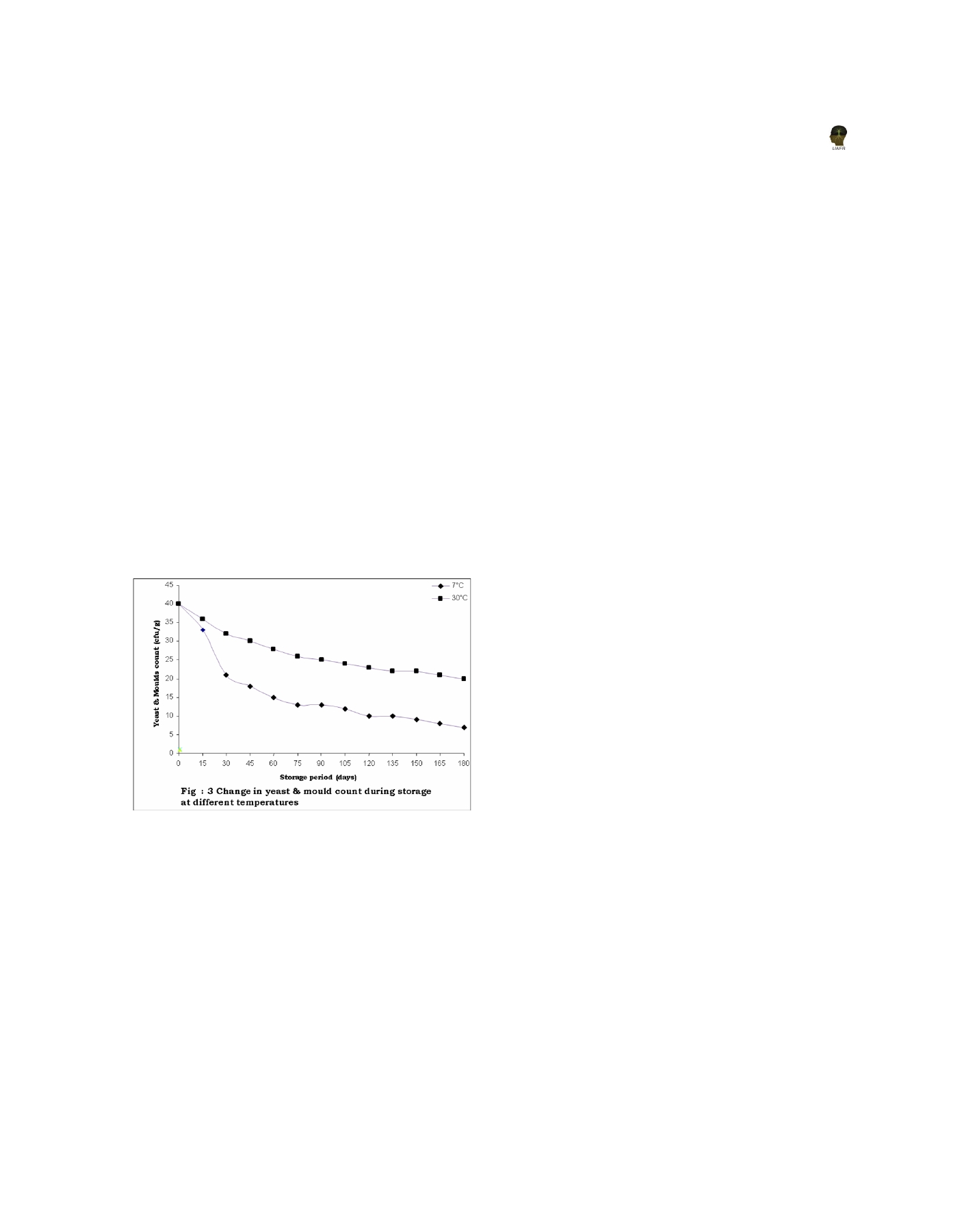
Effect of storage conditions on yeast and mold count
However, the temperature as well as intervals of storage
The changes in yeast and mold count (cfu/g) in pumpkin
individually had significant (p<0.01) influence on the
powder during storage at different temperatures in
retention of carotene in pumpkin powder.
metalized aluminium pouches are shown in Fig. 3. The
Storage stability of pumpkin powder
yeast and mold count also showed a decreasing trend
during the entire period of storage at both the storage
The results confirm that the microbial quality of the
temperatures. Lower the temperature of storage faster
pumpkin powder remained good even after the storage
was the rate of decrease of yeast and mold count. For
for 180 days, both at the temperatures of 7°C & 30°C.
example, at 90 days of storage, the yeast and mold count
However, there was gradual reduction was observed
at 7°C and 30°C were 13 and 25 cfu/g, respectively.
in the carotene content of the pumpkin powder during
But, at 180 days of storage the yeast and mold count at
storage. Though the loss in carotene content was high at
7°C and 30°C were only 7 and 20 cfu/g, respectively.
30°C storage temperature, it was only 17% at the end of
This was probably because of the fact that the optimum
180 days of storage at 7°C. These samples were stored
temperature for growth and survival of yeast and mold
in dark chamber and maintained at 80 and 62% RH,
is between 20 and 30°C. Hence the rate of decrease of
respectively.
yeast and mold count at 30°C is lower as compared to
The carotene degradation was faster when the pumpkin
that at 7°C storage temperature. The above results are in
powder was stored at 30°C as compared to that at 7°C.
good agreement with the results reported by several other
The carotene content in the powder after 30 days of
investigators (Khamrui and Pal., 2003; Adu- Gyamfi.,
storage at 30°C was similar to the value after 90 days of
2006).
storage at 7°C. Carotene content in powder after 75 days
of storage at 30°C was similar to the value after 180 days
of storage at 7°C.
Pumpkin powder was found to be more stable at 7°C
temperature of storage as compared to that at 30°C. The
powder can be safely stored at 7°C for almost 180 days.
Alternatively, at 30°C, the pumpkin powder should not
be stored for longer period than 75 days.
Conclusion
Duringstorageofpumpkinpowder,thestoragetemperature
and period had a significant effect on carotene retention
in the product. As the storage period was increased
Effect of storage conditions on coliform count
from 0 to 180 days, the carotene retention was found
to decrease. More carotene could be retained (82.95%)
During the storage of pumpkin powder at different
when pumpkin powder was stored at 7°C as compared
temperatures, it was found that the coliform which were
to 52. 28% retention at 30°C when the stored for 180
absent initially remained absent throughout the period
days. Standard plate count of powder stored at 7°C was
of storage (180 days). Absence of coliform during entire
found to be only 440 cfu / g at the end of 180 days of
storage period at both the temperatures indicates that
storage. Similarly, yeast and mold count observed at the
hygienic conditions were maintained during preparations
end of 180 days storage was only 7 cfu/g. Coliform was
and further no toxins are produced in the pumpkin powder
found to be absent throughout storage. Pumpkin powder
during storage.
was found to be more stable upto only 75 days, if stored
Statistically, temperature of storage had significant effect
at 30°C. However, it can be safely stored for almost 180
on SPC and yeast & mold count during the storage.
days, if stored at 7°C.
425