Dixit et al.
Physiological and Biochemical Characterization
motility test: Motility was examined following hanging drop method. One small
drop of exponentially grown broth culture of strains was dropped in the center of a
cover glass which was hanging in cavity slide. The cavity was sealed with paraffin
wax and observed for bacterial motility under 100 X objective of compound light
microscope.
generation time: A loopful log phase culture of each isolate was inoculated
separately in flasks containing respective media at 28±2°C and 150 rpm. Bacterial
growth of each isolates was assessed by measuring the optical density at 600
nm after every 6 h in UV-VIS spectrophotometer (Labtronics-model LT 2800,
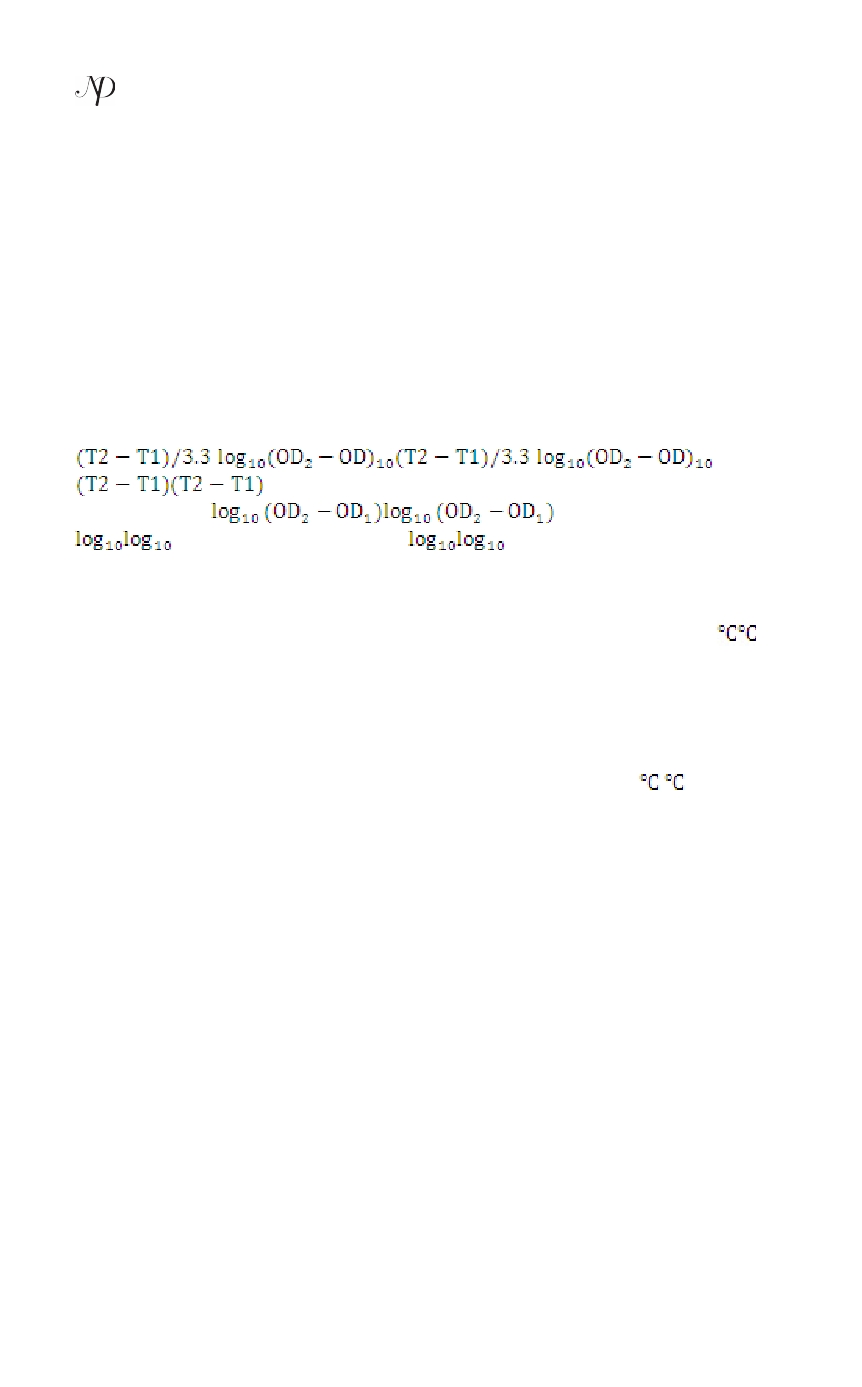
India). Generation time was calculated by using the formula: generation time =
, where
= time interval taken at any two points in the log phase
of growth and
= difference between the
value of OD at time T 2 h to
value of OD at time T 1 h (Dubey
and Maheshwari, 2012).
temperature tolerance: All the isolates were streaked onto the respective medium
and incubated at different temperature regime viz., 5, 15, 25, 35, 45 and 55
for
72h to examine the temperature tolerance ability of the isolates (Jida and Assefa,
2011).
pH tolerance: The ability of the bacterial isolates to grow in alkaline or acid
media was assessed using respective agar medium at different pH viz., 3, 4, 5, 6,
7, 8, 9 and 10 (by using HCL or NaOH) and incubated at 28±2
for the 72h
(Jida and Assefa, 2011).
Salt tolerance: Bacterial isolates were tested for their salt tolerance on respective
medium supplemented with 0.5, 1, 2, 3, 4, 5, 6 and 7 % (w/v) NaCl (Ben Romdhane
et al ., 2006).
catalase activity: Drops of hydrogen peroxide (3%) were added over to 48 h old
bacterial cultures. The plates were observed for the liberation of effervescence of
oxygen around the bacterial colonies (Graham and Parker, 1964). Bacterial isolates
exhibiting oxygen evolution confirmed the presence of catalase activity.
gelatin Hydrolysis: Culture tubes containing sterilized agar medium amended
with 0.4% (w/v) gelatin were separately stabbed by exponentially grown culture
of bacterial isolates and incubated at 28±2°C for the 7 days. The tubes were
observed for liquefaction of gelatin. Culture tubes showing liquefaction of gelatin
confirmed for gelatin hydrolysis (Sadowsky et al ., 1983).
Hydrolysis of urea: Log phase cultures of isolates were inoculated in the tubes
containing broth amended with 2% (w/v) urea and 0.012% phenol red and
98
Int. J. Bioinformatics and Biological Sci.: v.2 n.1&2, p. 95-109. March & June 2014