Dixit et al.
The bacterial isolates were identified on the basis of similarity with standard strains
and their morphological and physio-chemical features along with carbon utilization
characteristics as described in Bergey’s Manual of Systematic Bacteriology
(George et al ., 2004). Results of physio-biochemical characters along with carbon
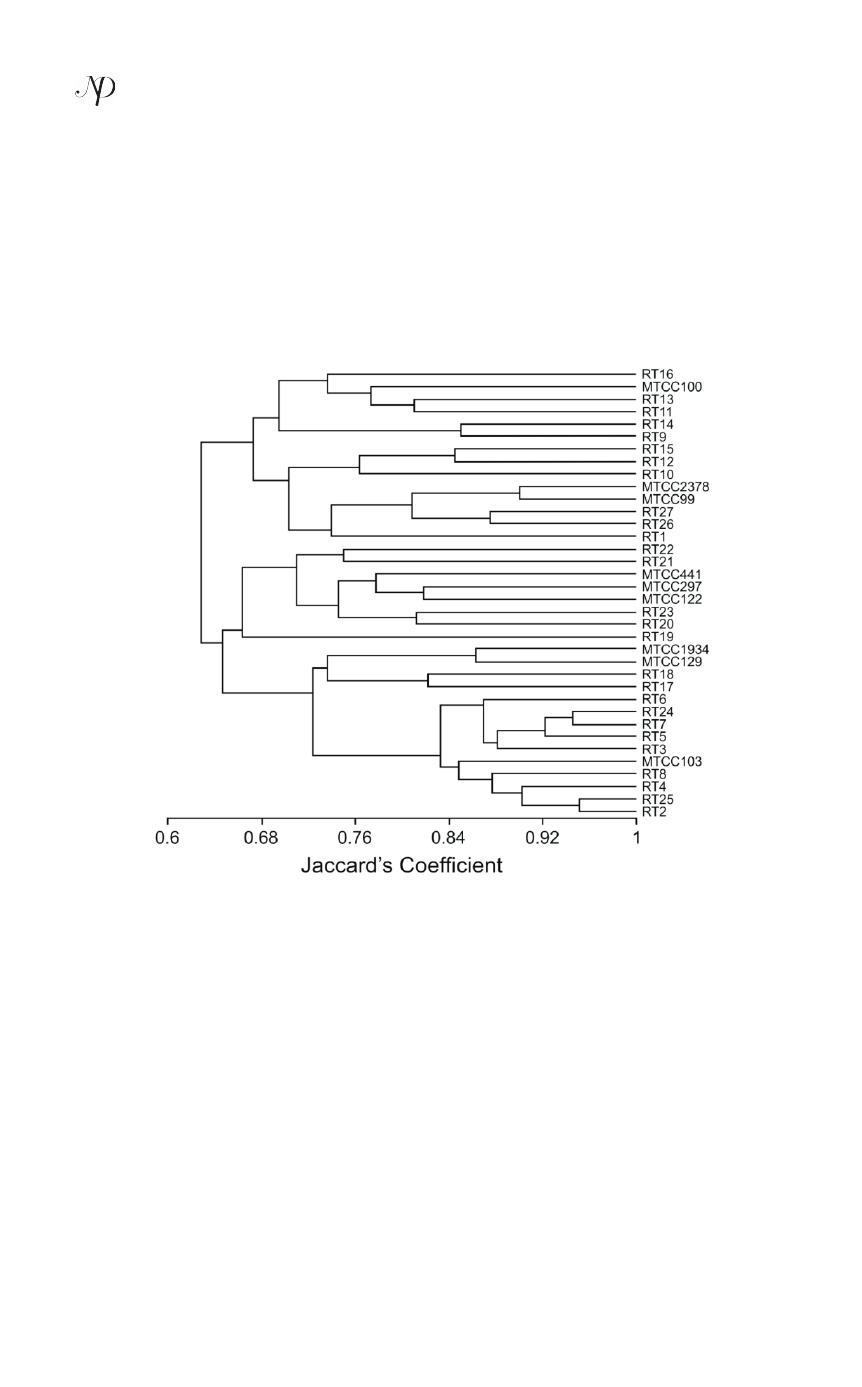
utilization property were computed by MVSP version 3.21 software to get the
Jaccard’s coefficient dendrogram that classified the isolates into the three major
groups i.e . RT1, RT9-RT16, RT26 and RT27 in one group, RT2-RT8, RT17-RT18,
RT24-RT25 in second group and RT19-RT23 in third group.
fig. 1: Dendrogram was obtained from endophytic bacterial isolates RT1–RT27 and
standard cultures Rhizobium Leguminosarum MTCC99, Sinorhizobium meliloti MTCC100,
Mesorhizobium loti MTCC2378, Pseudomonas fluorescens MTCC103, Pseudomonas
sp. MTCC129, Pseudomonas aeruginosa MTCC1934, Bacillus sp. MTCC297, Bacillus
subtilis MTCC441, Paenibacillus polymixa MTCC122. UPGMA (unweighted pair-group
method with arithmetic mean) clustering method based on Jaccards coefficien by using
physico-chemical characteristics and carbon utilization.
On the basis of similarity with the standard strains these isolates were named as
Rhizobium spp. for isolates RT1, RT9-RT16, RT26, RT27, Pseudomonas spp. for
isolates RT2-RT8, RT17-RT18 and RT24-RT25, and Bacillus spp. for isolates
RT19 - RT23 (Figure 1). Use of physiological and biochemical properties for
establishment of similarity among bacterial isolates by using MVSP software has
also been done by Dubey and Gupta, 2012.
104
Int. J. Bioinformatics and Biological Sci.: v.2 n.1&2, p. 95-109. March & June 2014