Malakar et al.
The forward selection procedure for the CCA resulted in the retention of eight
variablesassignificantcontributorstovariationintheordination.Thefirstordination
axis accounted for 44.83% of the variance of the species data, whereas the second
axis accounted for 18.62% of this variance (Table 3). Species abundances were
significantly correlated with the environmental factors (P=0.001 along axes one
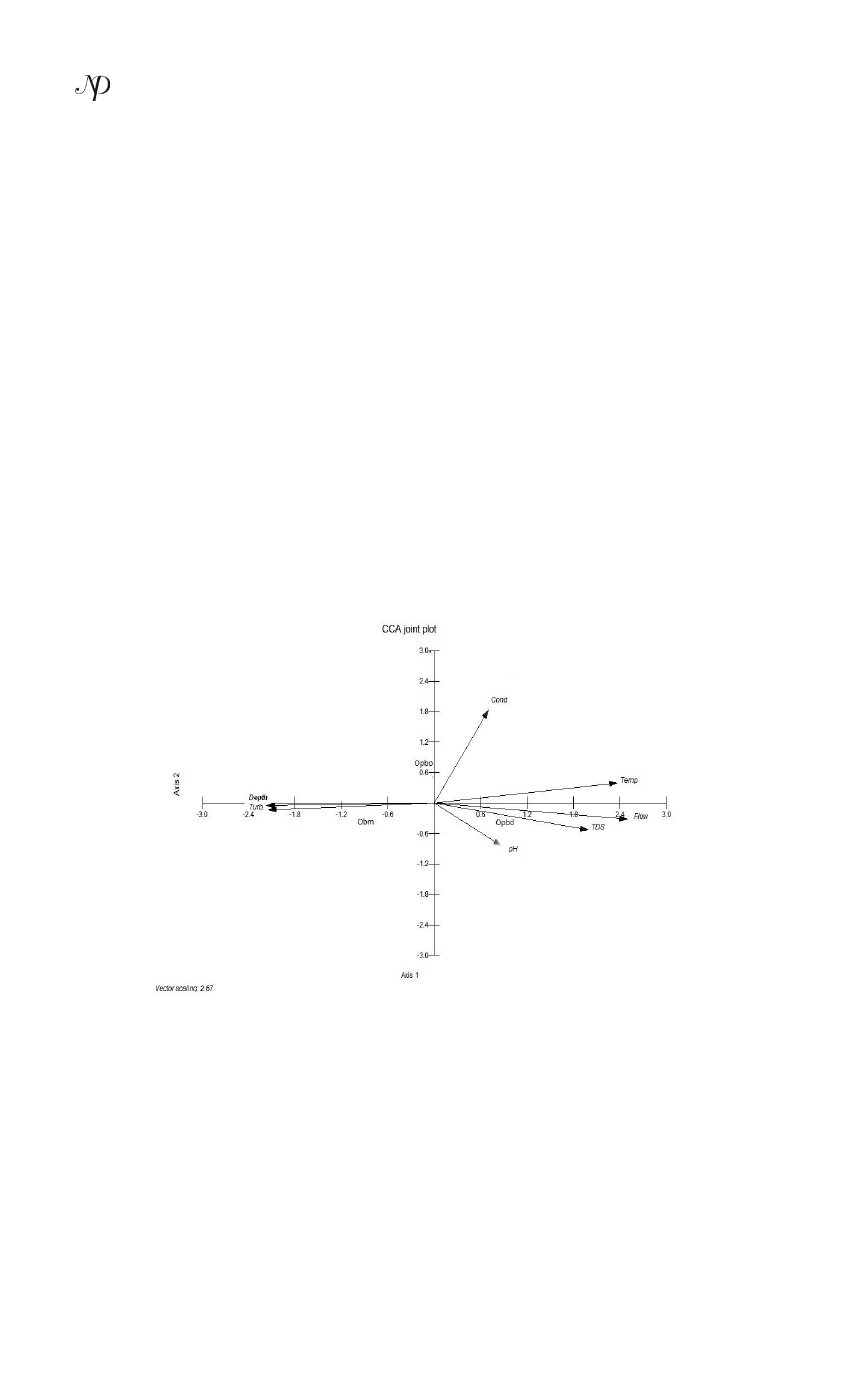
and two, Monte Carlo test with 1,000 permutations). Flow, temperature and TDS
were positively correlated with first ordination axis, whereas depth and turbidity
were negatively correlated (Figure 1). Conductivity was positively correlated with
second ordination axis.The species environmentcorrelationsof each axis were 0.90
(axis 1) and 0.64 (axis 2). Each significant environmental factor increased along a
vector away from the origin with its length being a measure of the magnitude. O.
pabda, O. pabo and O. bimaculatus were separated significantly from each other
in habitat space with respect to the significant habitat characteristics. O. pabda was
associated with the sites with fast water with shallow depth, high dissolve solids
with higher water temperature conditions. O. bimaculatus was associated with the
sites containing deep waters with slow water current and turbid water whereas,
O. pabo was associated themselves with the sites containing higher conductivity.
Figure 1. Canonical correspondence analysis showing correlation between species
composition and environmental variables.
ID: Opbo = Ompok pabo ; Opbd = Ompok pabda ; Obm = Ompok bimaculatus .
Localfishassemblagesarestructuredbyenvironmentalinfluencesatmultiplespatial
scales (Schlosser, 1982, 1987; Marsh-Matthews and Matthews, 2000). Species in
the present study displayed considerable differences in habitat associations. The
most important environmental variables for the assemblage of Ompok species in
140
International Journal of Bioinformatics and Biological Sciences : v.2 n.3&4. Dec. 2014