Production parameter optimization for laccases by Aspergillus niger
Dialysis
Pellet was dissolved in 0.01 M phosphate buffer with pH-7 and was dialysed
against the same buffer overnight at 4ºC.
Estimation of protein content of partially purified laccases
Protein content of the sample was measured by Lowry’s method and bovine serum
albumin (BSA) was used as standard (Lowery et al., 1951).
Results and Discussion
Optimization of culture conditions for laccase production
Effect of temperature on laccase activity
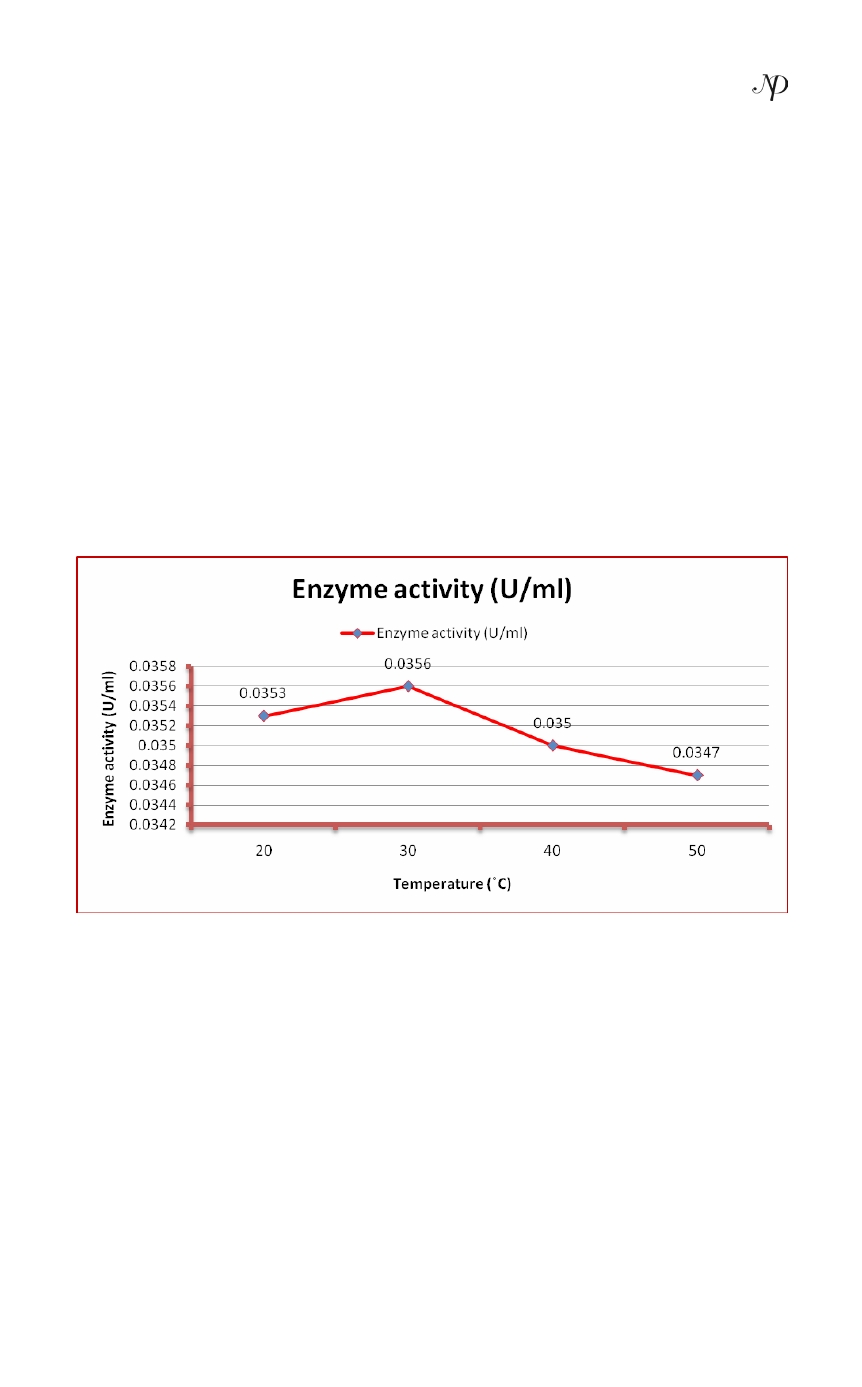
Highest laccase activity was observed at 30ºC(0.0356 U/ml) (Fig: 1). Similar
kind of study was conducted by Adejoye and Fasidi, (2009) in which effect
of temperature on laccase activity was studied and reported maximum laccase
activity (51.5 ± 2.21 U/ml) at 28°C.Rajeshwari and Parvantham, (2011) reported
maximum laccase production at 40°C.Incubation temperature plays an important
role in the metabolic activities of microorganisms. The optimal temperature of
laccase differs greatly from one strain to another.It has been found that 25°C is
the optimal temperature for laccase production in presence of light, but, in case of
dark, the optimal temperature is 30°C.Increase and decrease in temperature lead
to the gradual decrease in protein products. In the present in investigation there
was a gradual increase in enzyme activity from 20-40°C and at 50°C the enzyme
activity decreases.
Fig: 1 Effect of temperatureon laccase activity by Aspergillus niger
Effect of pH on laccase activity
Highest laccase activity was observed at pH 7 (0.0341 U/ml), while lowest
laccase activity was observed at pH 12 (0.0287 U/ml). (Fig:2).Similar kind of
study conducted Sivakumar et al. (2010) and the maximum release of laccase
activity of 0.24 U/ml was reported at pH 6.0 by Ganoderma sp. Study conducted
by Adejoye and Fasidi, (2009) in which the highest laccase activity of (2.86
U/min) was recorded at pH 5.5.Rajeshwari and Parvantham, (2011) reported
maximum laccase production at pH 5. pH is one of the important factor for the
International Journal of Bioinformatics and Biological Sciences : v.2 n.3&4. Dec. 2014
183