Development of a solid-state fermentation process for production of bacterial
Effect of Incubation temperature on alpha amylase production by Bacillus
licheniformis
Normally the incubation temperature for the alpha amylase production is much
related to the growth of the microorganism. Therefore the optimum incubation
temperature for the fermentation depends on whether the microorganism is
mesophilic or thermophilic. The bacterial alpha amylase is produced at much
wider range of temperature. In the present study alpha amylase produced by
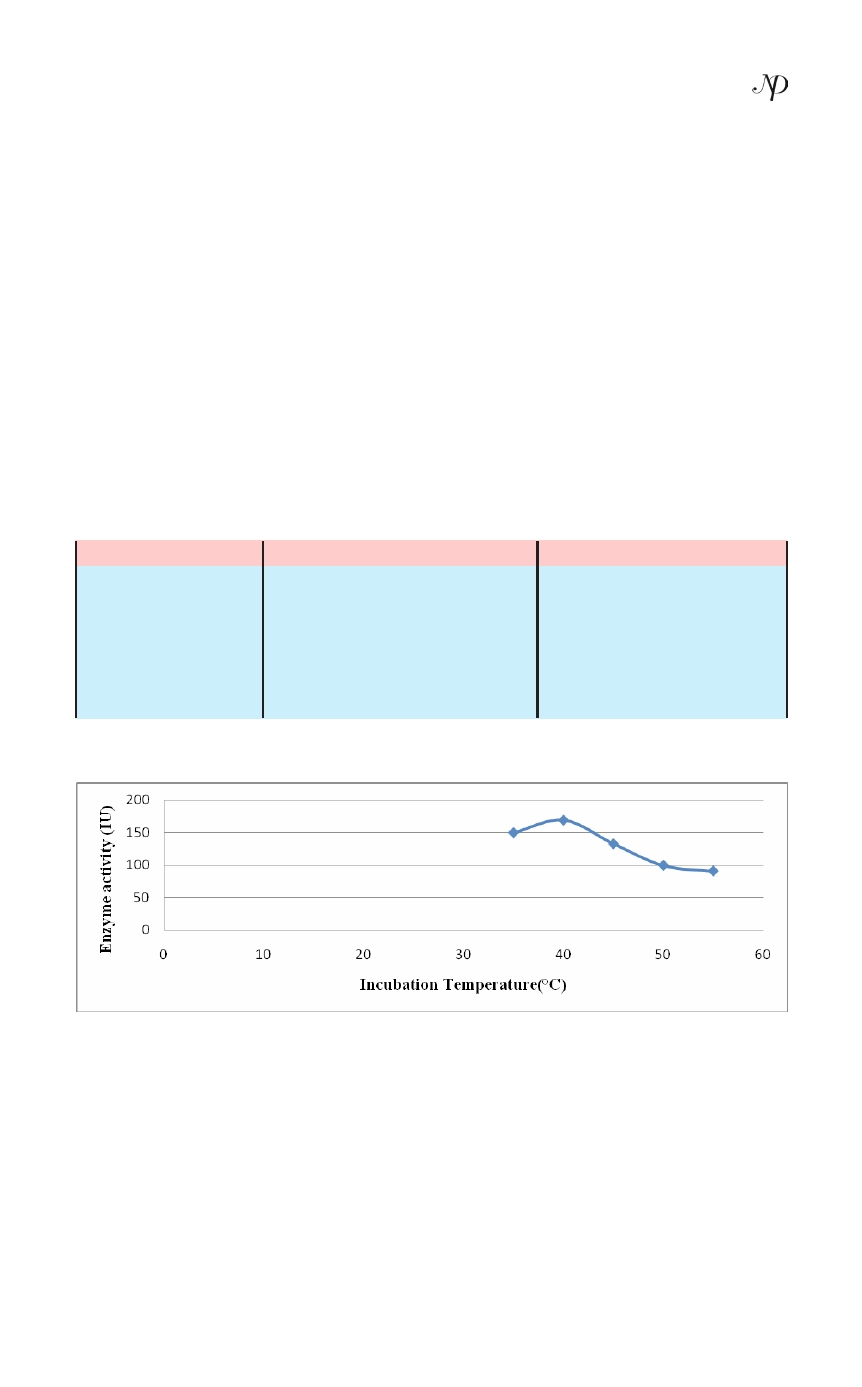
Bacillus licheniformis showed considerable enzyme activities in the range of 35°C
- 55°C. The enzyme activity increased upto 40°C (168.78 IU) and then the enzyme
activity dropped tremendously at 50°C and 55°C. The optimal temperature for
maximum amylase production (168.78 IU) was found to be 40°C (Table 5; Fig 5).
Table 5. Alpha amylase production by Bacillus licheniformis under different incubation
temperature of SSF medium
S.No
Incubation Temperature(oC)
Enzyme activity(IU)
1.
35
149.62
2.
40
168.78
3.
45
132.45
4.
50
99.32
5.
55
90.56
r =-0.89, tcal =-3.5>ttab =3.18 at 5% (S), Y = 296.96 - 3.75 X
Figure 5: Variation of alpha amylase production by Bacillus licheniformis under
different Incubation temperature of SSF
Similar results have been reported by Serin et al. (2012) for the production
of alpha amylase when rice bran was used with B. circulans at 37°C. Raj and
Hemashenpagam (2012) obtained maximum production of amylase at 55°C by
using Bacillus sp. It has also been reported that the metabolic heat generated
during microbial cultivation in SSF exerts harmful effects on the microbial
International Journal of Bioinformatics and Biological Sciences : v.2 n.3&4. Dec. 2014
213