Development of a solid-state fermentation process for production of bacterial
enzyme production behavior. Some carbon source supports good growth with low
enzyme production while other support good growth as well as enzyme secretion.
The present investigation was conducted to optimize fermentation medium with
carbon sources for industrial enzyme production. The experiment was conducted
on the production medium containing wheat bran and supplementation with
different carbon sources namely glucose, lactose, maltose, soluble starch at 1%
(w/v) concentration. The production medium was then fermented using Bacillus
licheniformis for the production of α- amylase. In the present study there was a
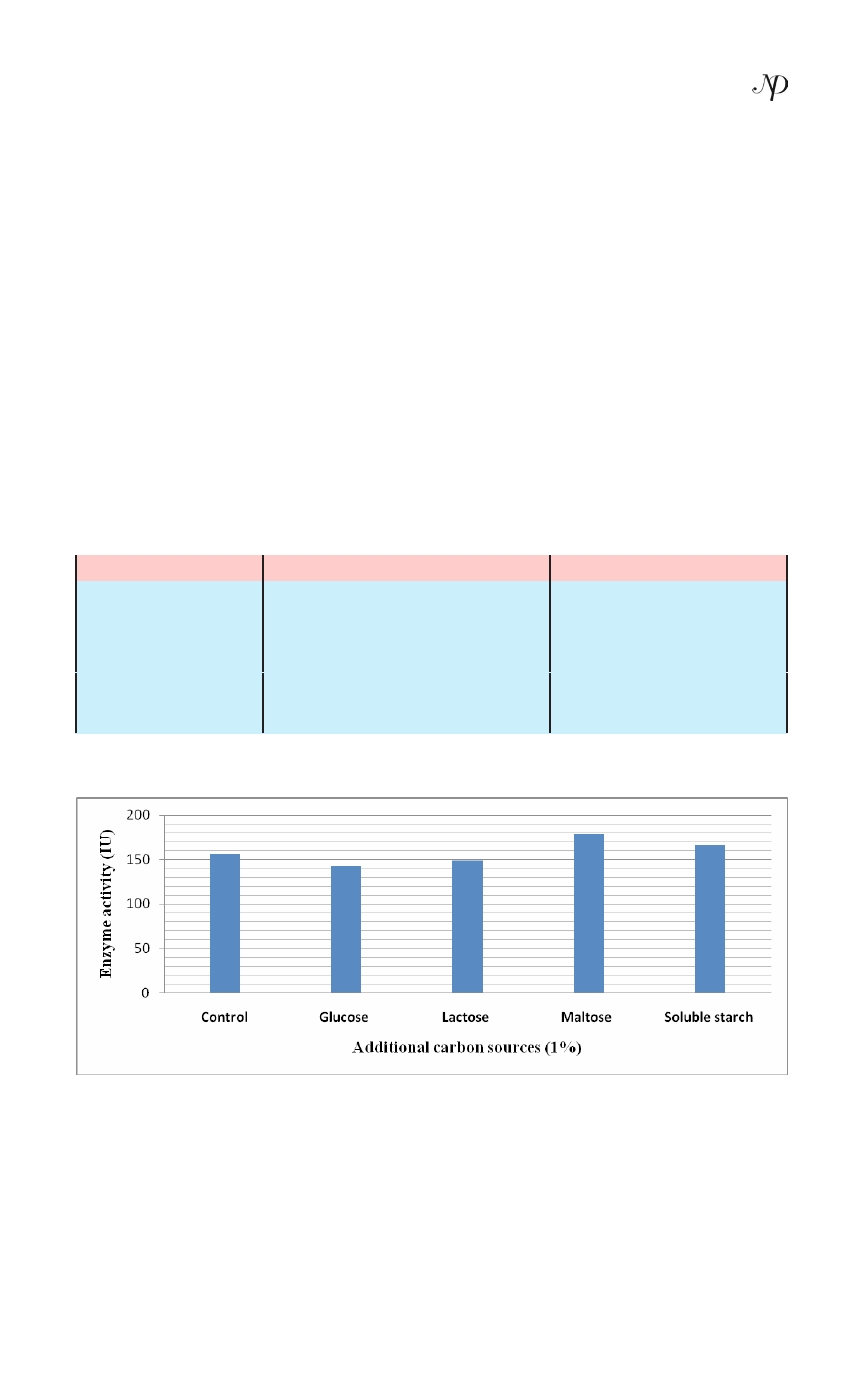
significant increase of amylase enzyme yield in media supplemented with maltose
(178.46 IU) whereas the production of α- amylase by B. licheniformis was
suppressed when bacterium was grown in the production medium with glucose
(142.44 IU) and lactose (148.68 IU) (Table 7;Fig 7).
Table 7. Production of alpha amylase by Bacillus licheniformis with additional carbon
sources supplemented to SSF
S.No
Carbon source
Enzyme activity(IU)
1.
Control
156.18
2.
Glucose (1%)
142.44
3.
Lactose (1%)
148.68
4.
Maltose (1%)
178.46
5.
Soluble starch (1%)
166.26
Fcal =606.48 > Ftab =11.25 at 1% (S)
Figure 7. Variation in α- amylase production by Bacillus licheniformis with additional
carbon sources supplementation
Similar result was also recorded by Babu and Satyanarayana (1995) where glucose
did not enhance α- amylase production by Bacillus coagulans under solid state
fermentation using wheat bran. Lactose exhibited repressive effect on enzyme
International Journal of Bioinformatics and Biological Sciences : v.2 n.3&4. Dec. 2014
217