Bile tolerance, Bile Deconjugation and Cholesterol reducing properties
salts (about 97%) are reabsorbed from the small intestine and returned to
the liver through the hepatic-portal circulation (Macdonald et al., 1983).
When they are deconjugated by bile salt hydrolase (BSH), the solubility
and emulsifying capacity decrease. BSH catalyzes the hydrolysis of
glycine and/or taurine conjugated bile salts into amino acids and free bile
acids (Liong & Shah, 2005). Some of the free bile salts precipitate at the
physiological pH of the intestinal lumen. Thus, in a steady-state situation,
deconjugationofbilesaltscanreduceserumcholesterollevelsbyincreasing
the formation of new bile salts needed to replace those that have escaped
the enterohepatic circulation (Reynier et al., 1981). Gilliland et al., (1985)
explainedȱthisȱeffectȱbyȱanȱassimilationȱofȱcholesterolȱthatȱoccurredȱwhenȱ
the Lactobacillus acidophilus was growing anerobically in the presence of
bile salts.
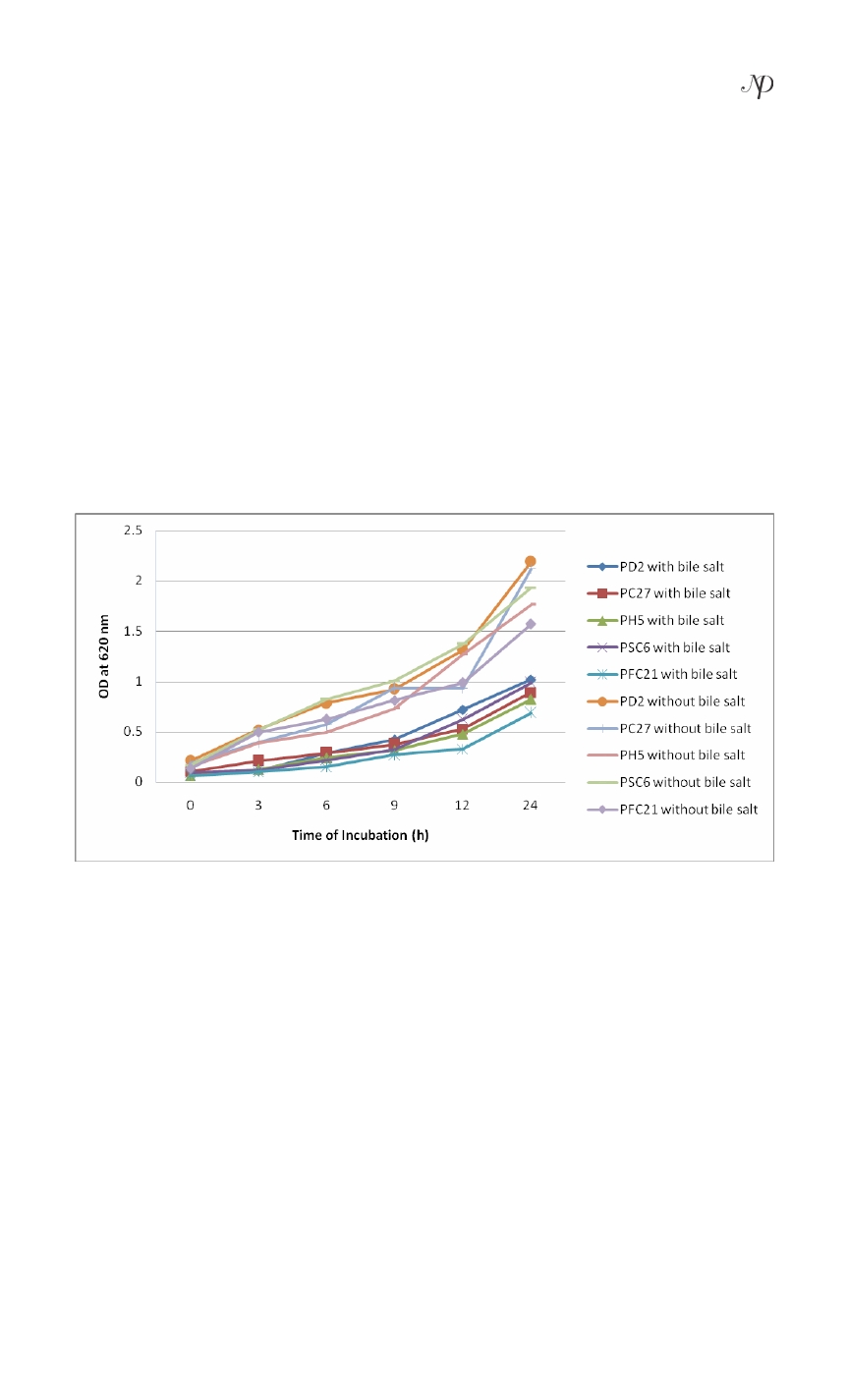
Fig. 1. Relative growth of different lactobacilli in presence and absence of bile salts.
The aim of this study was to compare various fermented food based
isolates of lactobacilli for their tolerance to bile salt (sodium taurocholate),
bile saltdeconjugation ability, and cholesterol removal ability.
Materials and Methods
Five strains of lactobacilli PD2, PC27, PH5, PSC6 and PFC21 were isolated
fromȱdosaȱbatter,ȱcurd,ȱhandvaȱbatter,ȱsoycurdȱandȱfermentedȱcabbage,ȱ
respectively. These cultures were maintained in 10 % reconstituted skim
milk by weekly transfers. Before use in the study, they were activated by
propogation in MRS broth by 2 daily transfers.
159