Human Research Development: A Case Study of an NGO in Assam
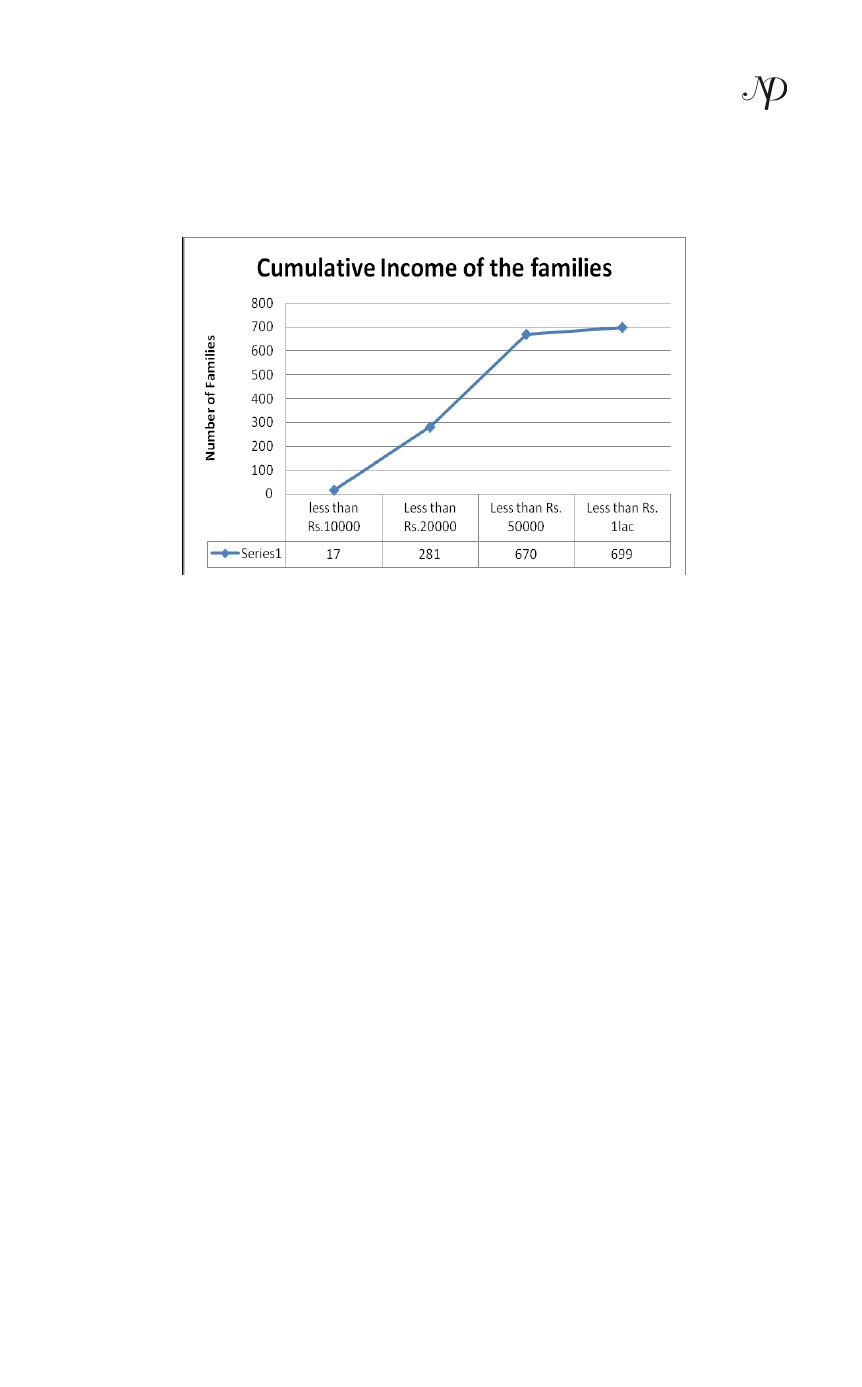
families, income of 389 families lies in the range of ` 20000 – ` 50000 and
264 families lies in the range of ` 10000 to ` 20000, 29 families lies in the
range of ` 50000 to ` 1 lac and 61 families lies above ` 1 lac while still 17
families lies below ` 10000.
Figure 1. Cumulative Income of the Families
¾ Till today many people are using only kerosene for lighting purpose. In
New Sonowal village, out of 111 families 49 families use kerosene, while
62 families use both kerosene and electricity, in Dani Gaon, out of 81
families, 25 families use kerosene and 56 families use both electricity
and kerosene, in Natun Mati, out of 92 families, 62 families use kerosene
while 30 families use both electricity and kerosene; in Ban Gaon, out
of 63 families, 55 families use kerosene, 7 families use electricity and
kerosene, while one family uses solar light lighting and kerosene. In
Sunapur, out of 70 families, 26 families use kerosene, 44 families use
electricity and kerosene. In Jungle Block, out of 98 families, 41 families
use kerosene while 57 families use both.
¾ Out of 760 families of that area (all the eleven villages) 727 families use
pond, 19 families use tube well, 6 families use river and 8 families use
both pond and tube well as their primary source of water. About 95%
people of that area who avail their drinking water from pond using simple
filtration (sand filtration), are not conscious about pure drinking water
and the various diseases which may occur from drinking impure water.
As a matter of fact, it was found that they frequently suffer from water-
borne diseases like Jaundice, Diarrhea, Typhoid, and Gastroenteritis etc.
A graphic representation of the number of families per village using the
different types of water sources is given below.
489