Invitro Effect of Zinc Treatment on the Antioxidant Status of ...Karan Fries Cows
concentration (291.19±10.30 ng/ml) of SOD was highest
in KF on the day of calving exposed to 42 o C whereas,
the concentration (142.97±15.97 ng/ml) was least in the
PBMC of Sahiwal at 37 o C during the postpartum period.
Zinc treatment decreased the concentration of SOD that
otherwise increased while exposing the PBMC to 42 o C
throughout the transition period in both the breeds.
The values of SOD showed an increasing trend on the day
of calving and during heat stress. These observations are
in agreement with the observations of Maurya et al. (2014)
who reported an increase in the SOD activity on the day of
calving with the levels being lower in the peripartum state.
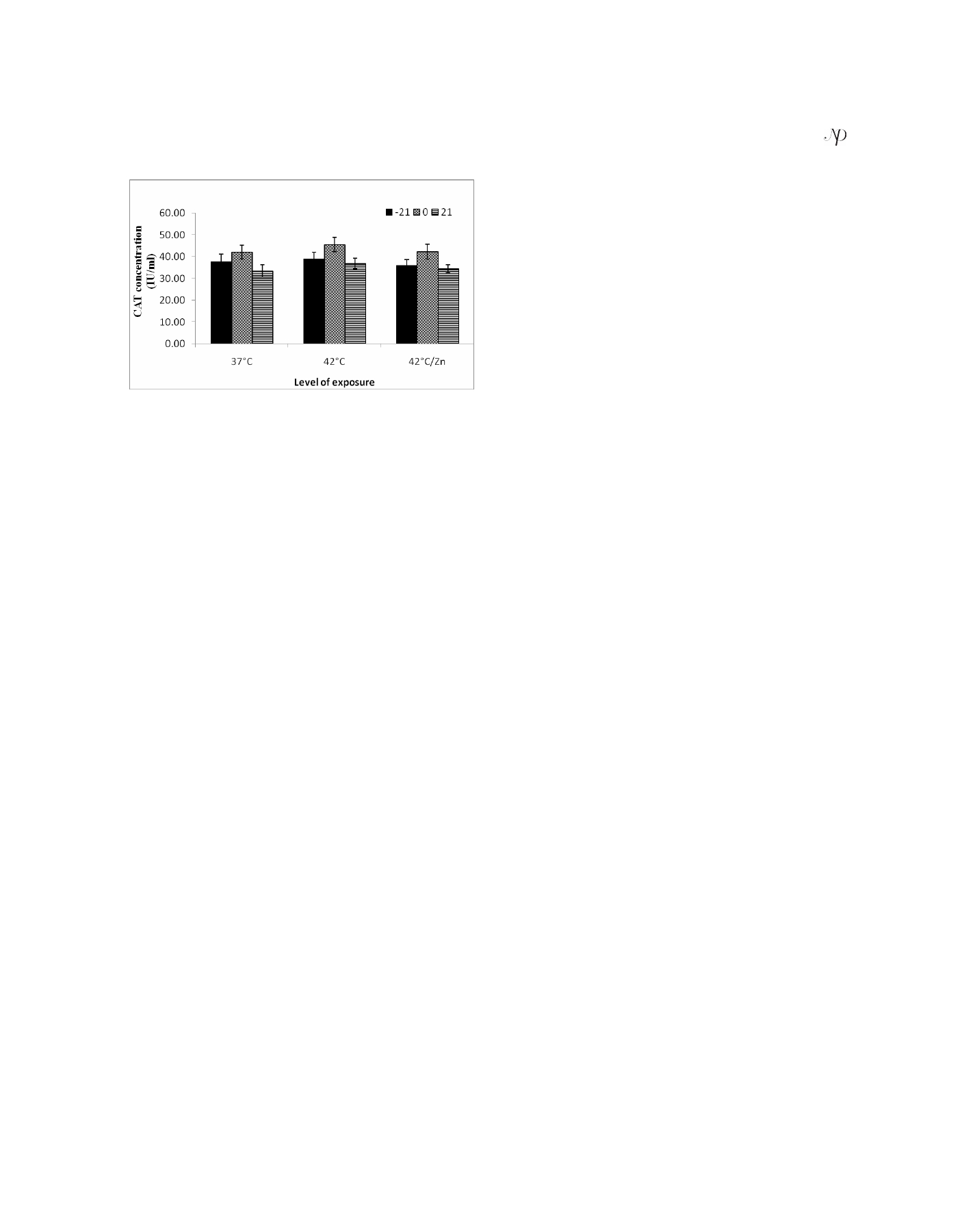
Figure 4. Changes in Catalase (IU/ml) under thermal stress
and Zinc treatment in Karan Fries transition cows
The levels were also lower in the zinc treated group as
they were in the Vitamin E supplemented group during the
experiment conducted by Maurya et al. (2014). Contrary
Statistical Analysis
to this, Aggarwal et al. (2013) showed a decline in the
SOD activity towards the day of parturition which further
The analysis of the data was performed using the SAS
decreased in the postpartum phase. The α-tocopherol
software (SAS Enterprise Guide 9.3 version) programme
treatment increased the levels of SOD on the respective
by three factor analysis of variance for breed * days
days. Bernabucci et al. (2005)alsoreporteddecreasedSOD
(peripartum) * in vitro treatment interaction using a
activity towards calving, and after calving, SOD activity
correlation coefficient at 0.05 level of significance. Data
rapidly declined. In the present study, the SOD activity
was expressed as Least square mean (LSM).
increased probably to combat the effect of free radicals
Y ijk = μ + Expo i + Br j + Days k + Expo*Breed + Br*Days +
and to improve cell survival. The levels of SOD are more
Days*Expo + Day*Expo*Breed + £ ijk
in KF as compared to Sahiwal which might be due to the
fact that KF has some exotic inheritance thereby making
Yijk = k th observation on i th level of exposure with j th breed
it more susceptible to heat stress. More free radicals are
µ = overall mean
formed in KF in response to heat and other calving related
stress. To combat them, more SOD is produced. Kumar et
Expo i = effect of i th level of exposure
al . (2011b) reported an increase in SOD level in caprine
Br j = effect of j th breed
during thermal stress. Singh et al. (2014) found that high
temperature did not increase ROS production significantly
Days k = effect on k th day
in Tharparkar but increased significantly (P<0.001) in
£ ijkl
= random error
Karan Fries cattle. The higher level of cytotoxicity seen in
crossbred KF cows indicated their susceptibility to hot dry
RESULTS AND DISCUSSION
environment as compared to zebu cows.
The changes in the concentration of SOD have been
The changes observed in the concentration of Catalase
presented in the Table 1 and are graphically represented
during the course of experiment are represented in the
in the figures 1 and 2. The SOD is significantly (P<0.05)
Table 2 and graphically depicted in the figures 3 and 4.
higher in the PBMC of Karan Fries than the Sahiwal cows
Catalase showed a variation in relation to the type of
with concentration of 255.03±16.67 and 188.42±9.95
exposure (37 o C, 42 o C and 42 o C/Zn) given to the PBMC
ng/ml, respectively. During the transition period, the
in culture. It also varied breed wise. The transition period
concentration of SOD was highest on the day of calving in
also has the influence on the concentration of catalase.
both the breeds at all the levels of exposure. Moreover, the
The concentration of Catalase was significantly (P<0.05)
concentration was highest at 42 o C as compared to 37 o C
higher in the PBMC of KF than Sahiwal cows. The
and 42 o C/Zinc in both the breeds on all the days. The
concentration in KF and Sahiwal was 38.60 ± 1.17 and
Journal of Animal Research: v.5 n.2. June 2015
247